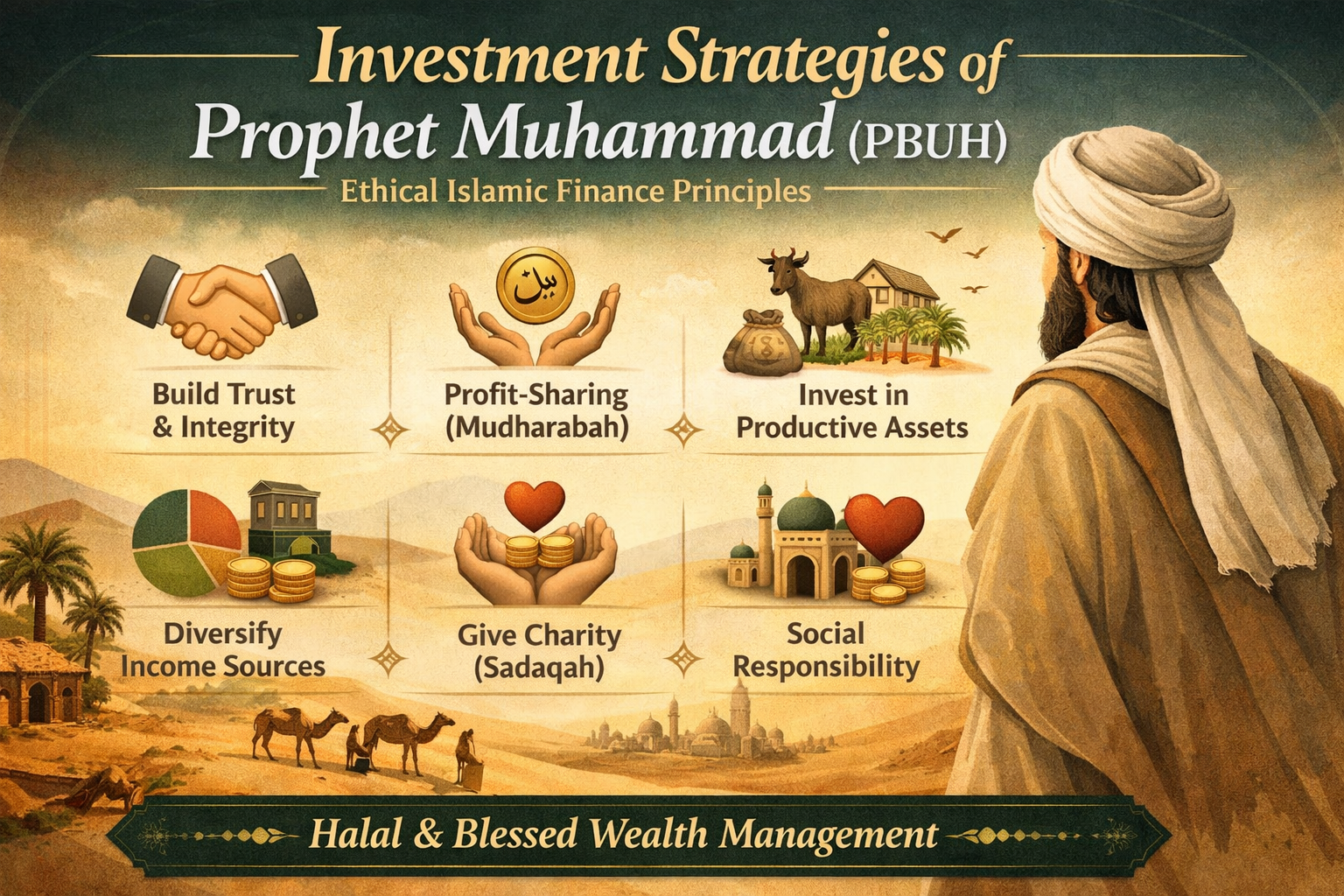
Financial management and investment are important aspects of building long-term stability and prosperity. In Islamic history, Prophet Muhammad (peace be upon him) was not only known as a spiritual leader but also as a highly respected businessman with strong financial intelligence.
Long before receiving prophethood, Prophet Muhammad was actively involved in trade and business. His reputation for honesty, fairness, and professionalism made him one of the most trusted merchants in Mecca. The financial principles he practiced can still serve as valuable guidance for modern investors who seek ethical, sustainable, and halal wealth management.
These investment principles emphasize not only profit, but also integrity, fairness, productivity, and social responsibility.
The Business Background of Prophet Muhammad (PBUH)
Before becoming the Messenger of Islam, Prophet Muhammad had extensive experience in commerce. From a young age, he participated in trading activities, traveling with caravans and learning the dynamics of markets and business negotiations.
His honesty and reliability earned him the title Al-Amin, which means the trustworthy. Because of this reputation, many wealthy individuals entrusted their capital to him to manage trade ventures.
One well-known example is when Khadijah bint Khuwaylid, a successful businesswoman in Mecca, entrusted her trading capital to Prophet Muhammad. He managed her business with exceptional professionalism and integrity, generating profitable returns while maintaining ethical conduct.
This historical example highlights the importance of trust, reputation, and professionalism in investment and financial partnerships.
Islamic Investment Principles Inspired by Prophet Muhammad
The financial practices of Prophet Muhammad reflect key principles that are still relevant for modern investment strategies, particularly within Islamic finance.
1. Building Trust as the Foundation of Investment
Trust is one of the most valuable assets in any business or investment relationship. Prophet Muhammad demonstrated that honesty and transparency are essential in building long-term financial partnerships.
His reputation as Al-Amin made investors confident in entrusting their wealth to him. This trust enabled him to manage trade capital effectively and expand business networks.
For modern investors and entrepreneurs, this lesson emphasizes that credibility, ethical behavior, and transparency are crucial for sustainable financial success.
Businesses that operate with integrity tend to attract stronger partnerships, loyal clients, and long-term investment opportunities.
2. Applying Profit-Sharing Partnerships (Mudharabah)
One of the financial practices associated with Prophet Muhammad’s business activities is profit-sharing partnerships, known in Islamic finance as mudharabah.
In this system:
- One party provides the capital
- The other party manages the business
- Profits are shared based on an agreed ratio
- Risks are shared fairly between both parties
This partnership model promotes fairness and cooperation while avoiding exploitation.
Today, mudharabah is widely used in Islamic banking, halal investment funds, and sharia-compliant financial products. It represents an ethical investment structure that encourages collaboration and mutual benefit.
3. Investing in Productive Assets
Another important strategy reflected in the Prophet’s financial practices is investing in productive assets that generate sustainable income.
For example, livestock such as goats, sheep, and camels were valuable economic assets at the time. They could provide ongoing benefits such as milk, wool, and trade value.
Investing in productive assets ensures that wealth continues to grow rather than remaining idle. This concept aligns with modern investment strategies such as:
- Real estate investment
- Agricultural businesses
- Productive enterprises
- Long-term income-generating assets
Productive investments create economic value and contribute to overall financial stability.
4. Utilizing Land and Agricultural Investments
In addition to livestock and trade, land and agriculture were also part of the economic activities during the time of Prophet Muhammad.
Some historical accounts describe how agricultural land and date plantations were managed through agreements where farmers cultivated the land and shared the harvest with the landowners.
This system allowed assets to remain productive without requiring constant direct involvement from the owner.
Today, similar concepts exist in modern investment strategies such as:
- Agricultural investment
- Land leasing
- Real estate partnerships
- Passive income investments
These methods allow investors to benefit from productive assets while supporting economic activity.
5. Diversifying Sources of Income
One important lesson from the financial practices of Prophet Muhammad is the importance of diversification.
Rather than relying on a single source of income, economic activities were spread across multiple sectors such as:
- Trade and commerce
- Livestock management
- Agriculture and land cultivation
Diversification helps reduce financial risk and improves long-term economic stability.
This principle is widely recommended in modern financial planning, where investors are encouraged to spread investments across different assets such as stocks, real estate, businesses, and commodities.
6. Charity and Social Responsibility in Wealth Management
A unique aspect of Islamic financial principles is the emphasis on charity and social responsibility.
Prophet Muhammad regularly shared his wealth with those in need through charity (sadaqah). In Islam, wealth is not solely a personal possession; it carries a social responsibility to support the community.
Giving charity also helps maintain balance in financial life. It promotes compassion, reduces inequality, and strengthens social solidarity.
In Islamic teachings, generosity is believed to bring barakah (blessings) to wealth and increase long-term prosperity.
Key Financial Lessons from the Investment Practices of Prophet Muhammad
Modern investors can learn several valuable principles from the financial strategies associated with Prophet Muhammad:
1. Integrity builds long-term success
Honesty and transparency are the foundation of sustainable business and investment.
2. Ethical partnerships create mutual benefit
Profit-sharing systems ensure fairness and encourage cooperation.
3. Productive assets generate sustainable income
Investments should focus on assets that produce long-term value.
4. Diversification reduces financial risk
Multiple income streams help maintain financial stability.
5. Social responsibility brings blessings
Sharing wealth through charity strengthens both society and personal financial well-being.
Applying Islamic Investment Principles in the Modern Era
Although economic systems have evolved significantly since the time of Prophet Muhammad, the core values of ethical finance remain timeless.
Today, these principles can be applied through:
- Halal investment funds
- Islamic banking products
- Ethical business ventures
- Socially responsible investing
By combining modern financial tools with ethical principles, investors can pursue both financial growth and spiritual fulfillment.
Conclusion
The investment strategies inspired by Prophet Muhammad demonstrate that financial intelligence and ethical conduct can go hand in hand. His approach to wealth management highlights the importance of honesty, fairness, productivity, and generosity.
These timeless principles provide valuable guidance for anyone seeking sustainable, halal, and socially responsible investment practices.
By applying these lessons, individuals can build wealth that is not only financially rewarding but also meaningful and blessed.