Harvard Experts Warn About the Risks of AI in Education: A Potential Threat to Students’ Thinking Skills
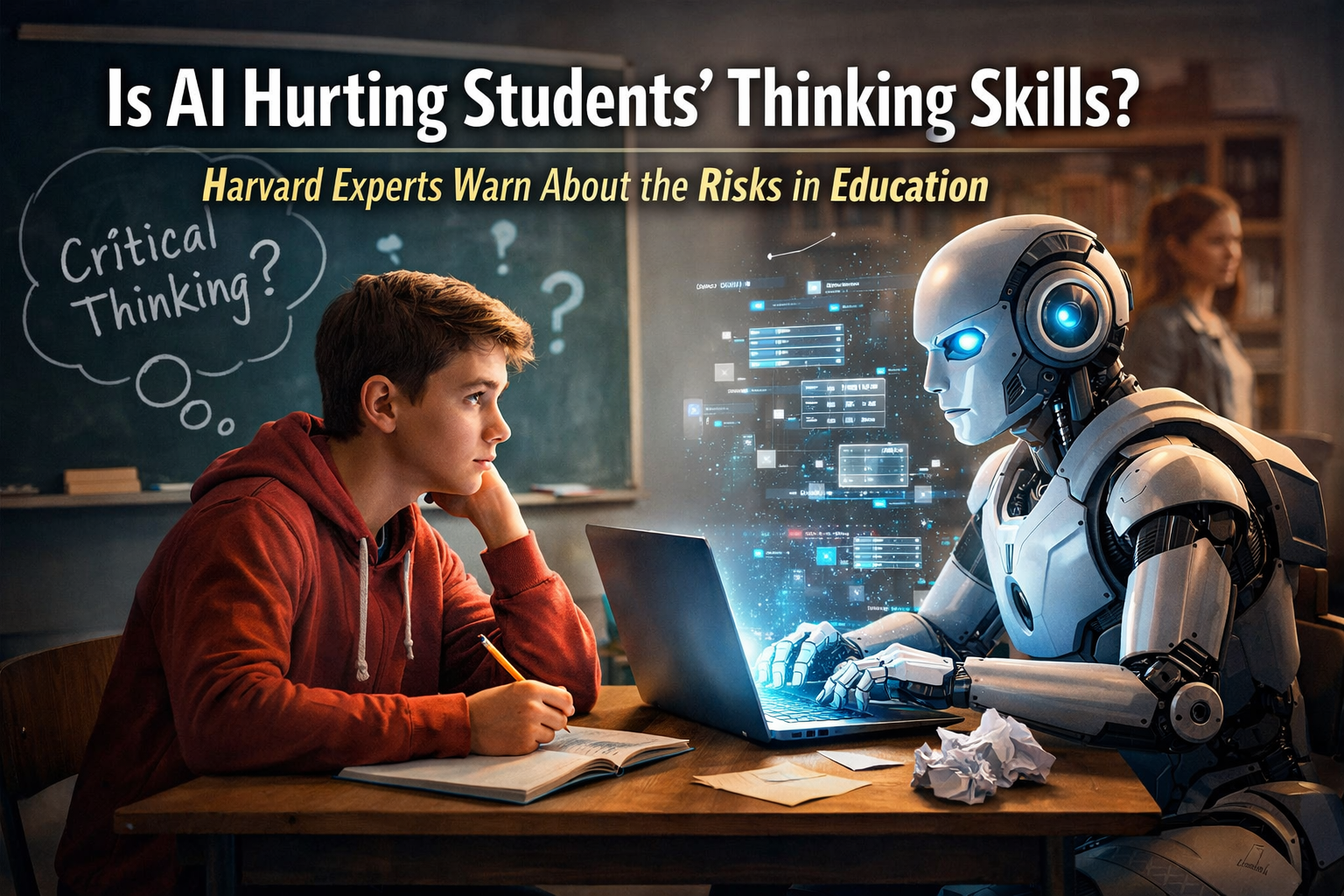
The rapid development of artificial intelligence (AI) has transformed many aspects of modern life, including education. From generating essays to solving complex equations within seconds, AI tools offer speed and convenience that were once unimaginable. However, experts from Harvard University are now raising concerns about the long-term impact of this technology particularly on how students think and learn.
To better understand this issue, consider a simple analogy: using AI is like relying on a GPS. While it helps you reach your destination quickly and efficiently, constant dependence on it can weaken your ability to navigate on your own. If the system fails, you may struggle to find your way. Similarly, excessive reliance on AI in education may reduce students’ ability to think independently.
The Illusion of Learning Through Shortcuts
AI enables students to complete tasks faster than ever before. They can summarize lengthy materials, generate answers to difficult questions, and even write full assignments in seconds. While this appears highly productive, experts warn that it creates an illusion of learning.
True learning is not simply about arriving at the correct answer it is about the cognitive process behind it. This includes analyzing information, questioning assumptions, making connections, and forming conclusions. When students rely heavily on AI, they often skip these essential steps.
As a result, their understanding becomes superficial. They may know what the answer is, but not why it is correct or how it was derived. Over time, this weakens their intellectual foundation.
The Decline of Critical Thinking and Creativity
One of the most serious concerns highlighted by experts is the potential decline in critical thinking skills. Human intelligence develops through effort, struggle, and problem-solving. When AI removes these challenges, students lose valuable opportunities to train their minds.
Several risks emerge from this pattern:
- Reduced critical analysis: Students may accept AI-generated responses without verifying their accuracy or questioning their logic. This can be dangerous, especially when AI produces incorrect or biased information.
- Lower creativity: When students rely on AI to generate ideas, they may become less capable of thinking creatively or producing original work.
- Loss of personal voice: Writing and expression may become increasingly uniform, shaped by AI rather than by individual perspectives and experiences.
In the long term, this could lead to a generation of learners who are efficient at using tools but lack the ability to think deeply and independently.
Long-Term Implications for the Education System
The growing dependence on AI does not only affect individual students—it also has broader implications for the education system as a whole.
Experts warn that if AI is used without proper guidance:
- The role of teachers may be undervalued, as students turn to AI as their primary source of answers.
- Classroom learning may lose its significance, becoming more of a formality than a meaningful experience.
- The fundamental goal of education—developing critical thinking, reasoning, and problem-solving skills—may be compromised.
If left unaddressed, these changes could reshape education in ways that prioritize convenience over comprehension.
Finding the Right Balance: AI as a Tool, Not a Replacement
Despite these concerns, Harvard experts do not suggest rejecting AI altogether. Instead, they emphasize the importance of using AI responsibly and strategically.
AI should function as a supporting tool, not a substitute for thinking. When used properly, it can enhance the learning process by:
- Helping students find relevant information quickly
- Providing explanations and alternative perspectives
- Offering feedback to improve understanding
However, students must remain actively engaged in their own learning. They should still practice analyzing problems, developing arguments, and expressing ideas in their own words.
Building Smarter Learning Habits in the Age of AI
The key challenge moving forward is not whether AI should be used in education, but how it should be used. Educators, students, and institutions must work together to create a balanced approach that leverages technology without sacrificing essential cognitive skills.
Students should be encouraged to:
- Use AI as a guide, not a shortcut
- Question and verify the information they receive
- Reflect on their learning process
- Develop independent thinking habits
Ultimately, education is not just about obtaining answers it is about shaping the way we think. AI may change the tools we use, but it should never replace the human ability to reason, question, and create.