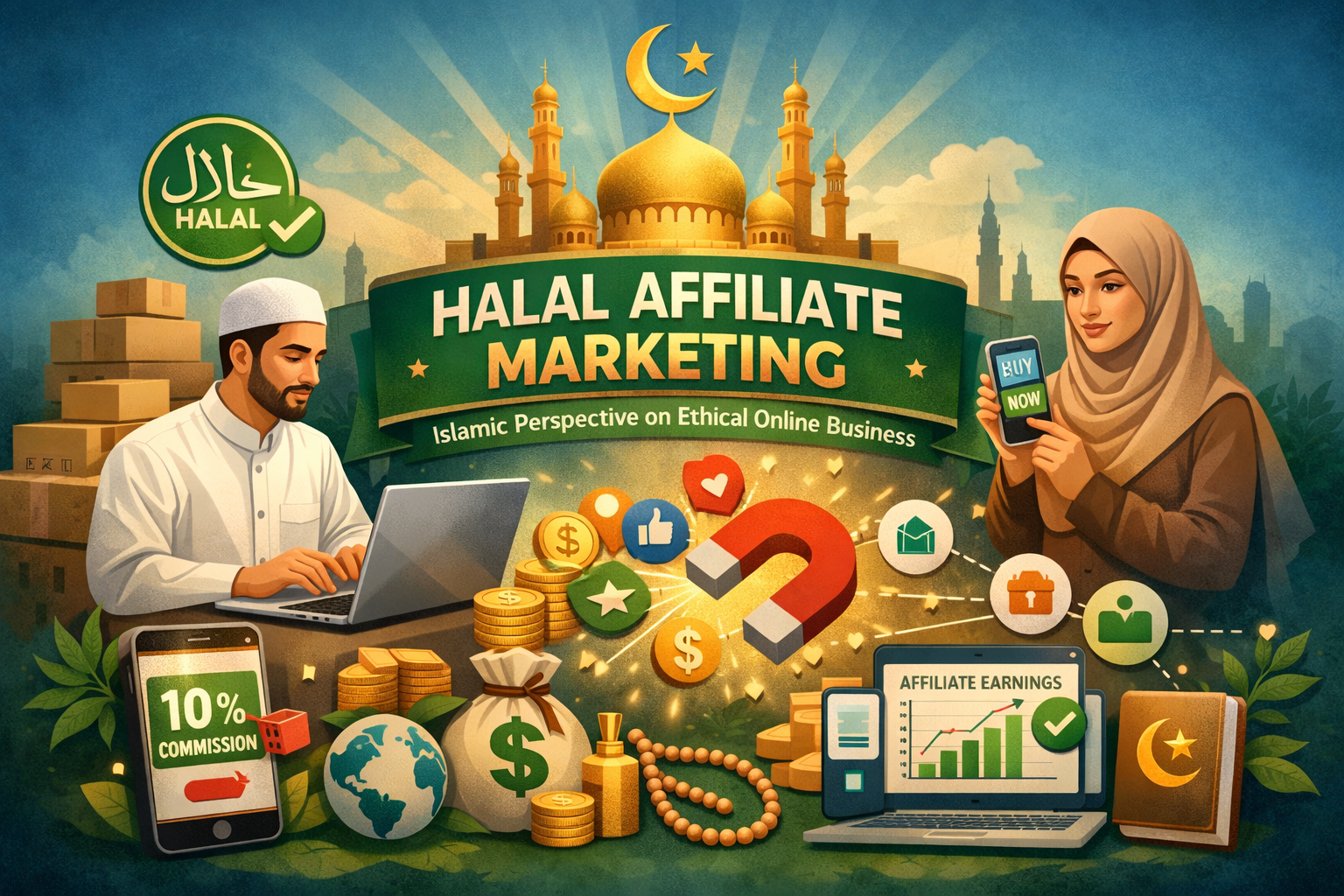
Halal Affiliate Marketing: An Islamic Perspective on Ethical Digital Business
Introduction
Affiliate marketing has become one of the most popular online business models in the digital era. It allows individuals to earn commissions by promoting products or services through blogs, social media, websites, or other digital platforms. However, for Muslims, an important question arises: Is affiliate marketing halal in Islam?
The concept of halal affiliate marketing is increasingly discussed as more Muslims participate in the digital economy. While affiliate marketing offers flexibility, passive income potential, and low startup costs, it must comply with Islamic principles to be considered permissible (halal).
This article provides a comprehensive review of affiliate marketing from an Islamic perspective, discussing its legality, ethical considerations, scholarly opinions, and practical guidelines for Muslims who wish to engage in affiliate marketing while remaining faithful to Shariah principles.
What Is Affiliate Marketing?
Affiliate marketing is a performance-based marketing model where an individual (affiliate) promotes a product or service offered by a merchant. When a sale or specific action occurs through the affiliate’s referral link, the affiliate earns a commission.
Key Components of Affiliate Marketing
- Merchant (Seller) – The business offering products or services
- Affiliate (Marketer) – The promoter who markets the product
- Consumer (Buyer) – The end user who makes a purchase
- Affiliate Network or Platform – The system tracking sales and commissions
This model is widely used by companies such as Amazon, Shopee, Tokopedia, and many digital service providers.
Understanding Halal and Haram in Islamic Business
Before assessing affiliate marketing, it is essential to understand Islamic business principles.
Core Islamic Commercial Ethics
Islamic transactions must avoid:
- Riba (Interest or Usury)
- Gharar (Excessive uncertainty or deception)
- Maysir (Gambling or speculation)
- Haram products or services
- Dishonesty and fraud
Islam encourages trade (tijarah) that is transparent, fair, mutually beneficial, and based on real economic activity.
Allah says in the Qur’an:
“Allah has permitted trade and forbidden riba.” (Qur’an 2:275)
Thus, any business model, including affiliate marketing, must be evaluated against these principles.
Is Affiliate Marketing Halal in Islam?
General Ruling
Most contemporary Islamic scholars agree that affiliate marketing is halal (permissible) as long as it meets specific conditions.
Affiliate marketing is essentially a form of wakalah (agency) or samsarah (commission-based brokerage), both of which are recognized in Islamic jurisprudence.
Why Affiliate Marketing Can Be Halal
- The affiliate earns a commission for marketing efforts
- No interest-based transactions are involved by default
- Income is earned through legitimate services (promotion and referral)
However, the permissibility depends heavily on what is promoted and how it is promoted.
Conditions for Halal Affiliate Marketing
To ensure affiliate marketing is halal, the following conditions must be met:
1. Promoted Products Must Be Halal
Affiliates must not promote:
- Alcohol, pork, or haram food products
- Gambling, betting, or lottery platforms
- Interest-based financial products (conventional loans, credit cards with riba)
- Adult or immoral content
- Any service prohibited in Islam
Promoting haram products makes the income haram (haram li ghairihi).
2. Transparency and Honesty
Islam strictly prohibits deception (tadlis).
Affiliates must:
- Clearly disclose affiliate links
- Avoid false claims or exaggerated benefits
- Provide honest reviews and accurate information
The Prophet Muhammad ﷺ said:
“Whoever deceives is not one of us.” (Muslim)
3. Clear Contract and Commission Structure
The commission agreement must be:
- Clearly defined
- Known to both parties
- Free from ambiguity (gharar)
Affiliates should understand:
- How commissions are calculated
- When payments are made
- Conditions for commission eligibility
4. No Riba or Unethical Financial Practices
Affiliate marketing becomes haram if:
- Commissions are linked to interest-based systems
- It promotes riba-based institutions knowingly
- Payment methods involve prohibited financial mechanisms
5. Ethical Marketing Methods
Islam emphasizes akhlaq (good character) in business.
Avoid:
- Clickbait deception
- Fake scarcity tactics
- Misleading testimonials
- Spam or intrusive marketing
Ethical marketing aligns with Islamic values and builds long-term trust.
Affiliate Marketing Compared to Islamic Contracts
Affiliate marketing resembles several Islamic contracts:
1. Samsarah (Brokerage)
A simsar earns a commission for connecting buyers and sellers. This model is widely accepted in Islamic jurisprudence.
2. Wakalah (Agency)
The affiliate acts as an agent promoting products on behalf of the seller.
3. Ijarah (Service Contract)
The affiliate provides marketing services in exchange for compensation.
These contracts are halal if conducted with transparency and mutual consent.
Common Misconceptions About Affiliate Marketing in Islam
“Affiliate Marketing Is Passive Income, So It’s Haram”
This is incorrect. Islam does not prohibit passive income as long as it comes from halal sources and legitimate effort.
“No Physical Product Means It’s Haram”
Digital products and services are permissible if they provide real value and are halal.
“Affiliate Marketing Is Similar to MLM”
Affiliate marketing differs from pyramid schemes or MLM scams. MLM becomes haram when it involves exploitation, mandatory recruitment, or unclear compensation.
Halal vs Haram Affiliate Marketing Examples
Halal Affiliate Marketing Examples
- Promoting halal cosmetics
- Reviewing Islamic finance apps (Shariah-compliant)
- Affiliate blogs for modest fashion
- Marketing online education or productivity tools
Haram Affiliate Marketing Examples
- Promoting online gambling platforms
- Referring users to interest-based lending apps
- Marketing alcohol or adult websites
- Promoting scam or fraudulent products
How Muslims Can Start Halal Affiliate Marketing
Step 1: Choose a Halal Niche
Focus on:
- Islamic lifestyle
- Halal travel
- Health and wellness
- Education and technology
- Ethical e-commerce
Step 2: Join Halal-Friendly Affiliate Programs
Ensure the merchant:
- Sells halal products
- Uses ethical business practices
- Has transparent affiliate terms
Step 3: Create Value-Based Content
Use:
- Educational blog posts
- Honest product reviews
- Tutorials and guides
- Social media content with integrity
Step 4: Disclose Affiliate Relationships
Transparency builds trust and fulfills Islamic ethical requirements.
Step 5: Purify Income If Necessary
If doubtful income exists, scholars recommend:
- Avoiding it if possible
- Donating doubtful portions to charity (sadaqah) without intention of reward
Scholarly Opinions on Affiliate Marketing
Many contemporary scholars and fatwa councils agree:
- Affiliate marketing is halal with conditions
- The ruling depends on content, product, and method
Institutions such as:
- Dar al-Ifta
- Local Shariah advisory boards
- Contemporary Islamic finance scholars
have acknowledged the permissibility of commission-based online marketing under ethical guidelines.
SEO Benefits of Halal Affiliate Marketing Content
From a digital marketing perspective, halal affiliate marketing offers:
- Trust-based audience engagement
- Long-term brand authority
- Strong niche targeting
- High conversion due to ethical alignment
Popular SEO keywords include:
- Halal affiliate marketing
- Is affiliate marketing halal
- Islamic online business
- Halal digital income
- Shariah-compliant marketing
Challenges in Halal Affiliate Marketing
- Limited halal affiliate programs
- Need for continuous Shariah screening
- Misleading global platforms
- Lack of Islamic digital business education
However, these challenges also create opportunities for innovation.
The Future of Halal Affiliate Marketing
With the growth of the global halal economy, halal affiliate marketing is expected to expand rapidly. Muslim entrepreneurs are increasingly seeking:
- Shariah-compliant income streams
- Ethical digital entrepreneurship
- Faith-aligned online businesses
Affiliate marketing can play a vital role in empowering Muslims economically while upholding Islamic values.
Conclusion
Affiliate marketing, when practiced responsibly, transparently, and ethically, can be halal and fully compatible with Islamic principles. The key lies not in the business model itself, but in how it is executed.
Muslims engaging in affiliate marketing must ensure:
- Products are halal
- Marketing is honest
- Contracts are clear
- No riba or deception is involved
By adhering to Islamic ethics, halal affiliate marketing becomes not only a source of income but also a means of da’wah and ethical contribution to the digital economy.