Finding a Job Is a Full-Time Job: A Practical, Disciplined Approach to Career Transition
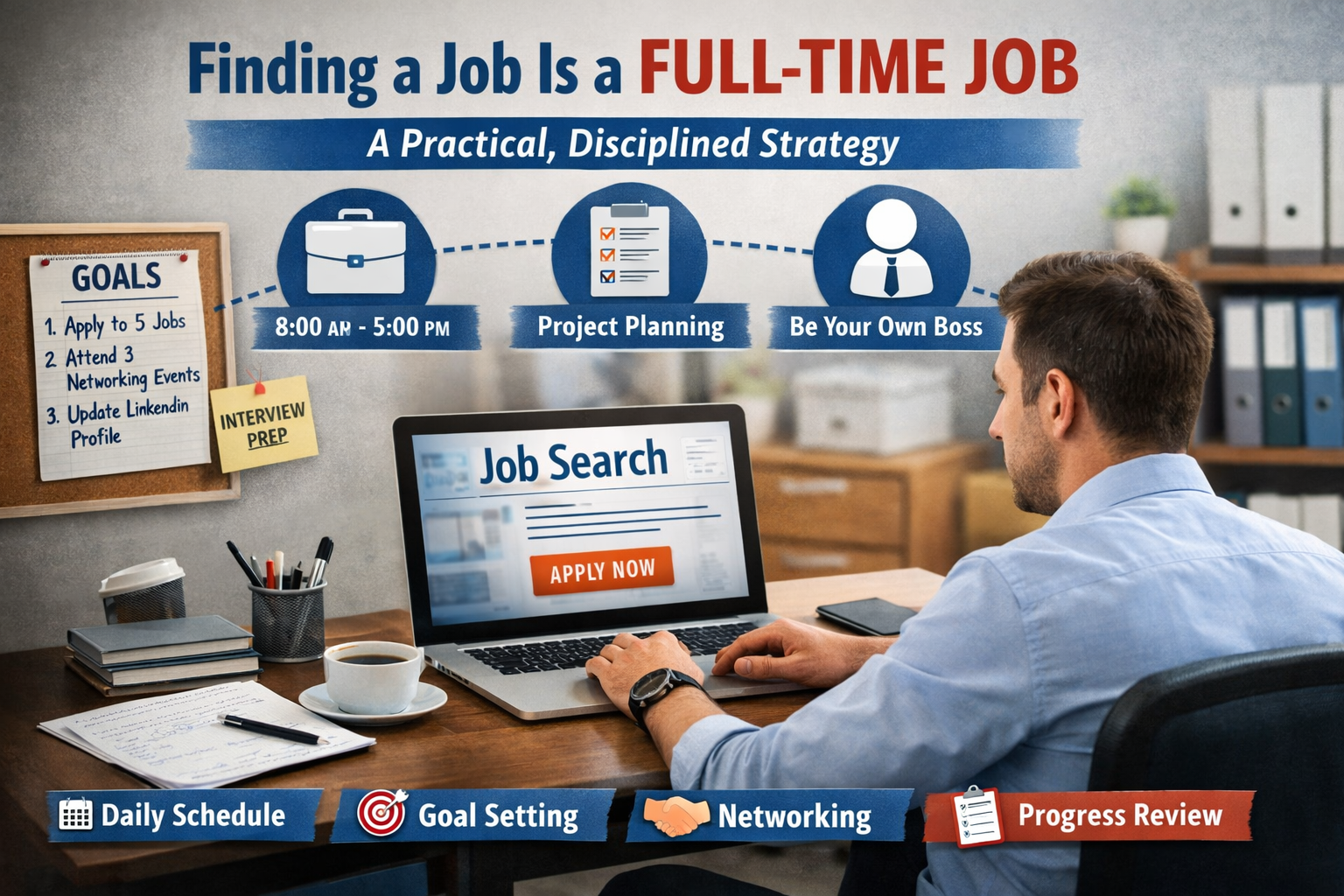
Finding a job is often treated as something informal—an activity squeezed between errands, family obligations, or moments of low energy. Many people approach it like a side project or a temporary inconvenience. This mindset, while understandable, is also one of the biggest reasons job searches drag on longer than necessary.
The reality is simple but uncomfortable: finding a job is a job. It requires structure, discipline, planning, accountability, and consistent execution. When approached casually, the process becomes inefficient, emotionally draining, and unpredictable. When approached professionally, it becomes manageable, measurable, and far more effective.
This article presents a practical framework for treating your job search the way successful professionals treat meaningful work: as a full-time role, a structured project, and a responsibility where you act as your own boss. This is not motivational theory—it is a method grounded in how work actually gets done.
Treating the Job Search as a Full-Time Role
Why Structure Matters More Than Motivation
If you were employed, you would not decide each morning whether you “felt like” going to work. You would show up at a consistent time, follow a routine, and stay engaged until the workday ended. Your income, reputation, and career progression would depend on it.
A job search deserves the same seriousness because the stakes are just as high—if not higher. Without structure, even highly motivated people drift. Days blur together. Tasks feel overwhelming. Progress becomes hard to measure.
Treating your job search like a full-time job creates psychological clarity. You know when the day starts, what needs to be done, and when it ends. This removes decision fatigue and replaces anxiety with rhythm.
Designing a Realistic Workday
A professional job search day might look like this:
- Start time: 8:00 or 9:00 a.m.
- Core work hours: Resume refinement, applications, networking outreach, interview preparation
- Breaks: One lunch break, short mental resets
- End time: 4:30 or 5:30 p.m.
This does not mean staring at job boards all day. In fact, that is one of the least productive uses of time. Instead, your day should include varied, intentional tasks that move you closer to employment.
For example:
- One hour customizing resumes or cover letters
- One hour researching companies or industries
- One hour reaching out to contacts or scheduling networking conversations
- One hour improving skills or preparing for interviews
By working regular hours, you maintain momentum without burning out.
The Cost of Treating It Like a Hobby
When job searching is treated as a part-time activity, it stretches indefinitely. People apply sporadically, network inconsistently, and prepare only when interviews appear. This reactive approach reduces confidence and increases frustration.
In contrast, consistency compounds. Five focused days per week—even without immediate results—build visibility, connections, and preparedness. Over time, this dramatically shortens the overall search.
Approaching the Job Search as a Project
Why Projects Succeed Where Effort Alone Fails
Projects succeed because they have goals, timelines, tools, and evaluation. A job search without these elements relies too heavily on hope.
When you frame your search as a project, you shift from emotion-driven action to outcome-driven execution. You stop asking, “Did I try hard today?” and start asking, “Did I complete the tasks that move this project forward?”
This shift creates control.
Defining Clear Objectives
Every project begins with a clear outcome. In a job search, this might include:
- A specific role or function
- Target industries or companies
- Geographic or remote preferences
- Compensation range
Without clarity, applications become unfocused and interviews mismatched. With clarity, every action supports a defined goal.
Breaking the Project into Workstreams
Successful professionals break large projects into manageable components. A job search should be no different. Typical workstreams include:
- Application strategy: identifying roles and tailoring materials
- Networking: building and maintaining professional relationships
- Research: understanding industries, companies, and trends
- Skill development: closing gaps that limit competitiveness
- Interview preparation: storytelling, case practice, confidence building
By organizing your work this way, you avoid the common trap of overinvesting in one area while neglecting others.
Applying Skills You Already Have
Ironically, many people abandon their professional skills when job searching. Project managers stop planning. Analysts stop tracking data. Leaders stop reviewing performance.
This is a mistake.
If you have ever managed deadlines, coordinated stakeholders, or measured results, you already know how to run a job search effectively. Apply those same tools—spreadsheets, calendars, weekly plans—to this project.
Becoming Your Own Boss
Why Accountability Is the Missing Ingredient
In a traditional job, accountability is external. A manager sets expectations, reviews performance, and addresses gaps. In a job search, that structure disappears—unless you replace it intentionally.
Being your own boss means holding yourself to professional standards even when no one is watching. This is not about harsh self-criticism; it is about clarity and responsibility.
Weekly Self-Reviews That Actually Work
One of the most effective practices is a weekly review meeting—with yourself.
This meeting includes two written reports:
1. A Performance Evaluation
This is a candid assessment of the previous week. It should answer:
- What did I plan to do?
- What did I actually do?
- What results did this produce?
Honesty matters more than optimism here. If little progress was made, document it without excuses.
2. A Forward Plan
This outlines the coming week with:
- Clear goals (e.g., number of networking conversations, applications, or interviews)
- Specific actions
- Priorities, not just intentions
This transforms vague effort into deliberate action.
Learning from Missed Goals
Missed goals are not failures—they are data.
For example, if you planned to attend twelve networking meetings but attended only two, the question is not “Why am I lazy?” but:
- Was the goal unrealistic?
- Did I underestimate preparation time?
- Are there logistical barriers I can remove?
One person might realize they need to schedule meetings earlier in the week. Another might discover that virtual meetings are more sustainable than in-person ones. These insights only emerge through reflection.
Adjusting the Plan Without Abandoning It
Good managers adjust plans based on evidence. If a strategy is not working, change the approach—not the commitment.
This might mean:
- Reducing the number of applications but improving quality
- Shifting from online applications to referrals
- Reallocating time toward skill-building
Progress comes from iteration, not perfection.
The Psychological Impact of Professionalizing the Search
Replacing Anxiety with Agency
Unstructured job searches create emotional volatility. Some days feel hopeful, others hopeless. Professional structure stabilizes this experience.
When you know you are showing up every day, following a plan, and measuring progress, anxiety loses its grip. You may not control outcomes, but you control execution—and that is empowering.
Maintaining Confidence Through Routine
Confidence erodes when effort feels scattered. Routine restores it. Even during rejection or silence, disciplined action reinforces self-respect and resilience.
This matters in interviews, where confidence is often more persuasive than credentials.
Why This Approach Shortens the Job Search
Consistency Builds Visibility
Most jobs are not filled through cold applications alone. They are filled through conversations, referrals, and trust. These require sustained presence—not occasional outreach.
A full-time, project-based approach ensures that visibility compounds over time.
Preparation Meets Opportunity
Opportunities rarely arrive when you feel ready. They arrive when timing aligns. Those who treat job searching professionally are prepared when that moment comes—because preparation has become routine, not reactive.
A Strong, Practical Conclusion
Finding a job is not a pause between careers—it is a career phase. Like any meaningful role, it demands discipline, planning, and accountability.
By treating your job search as:
- a full-time job,
- a structured project, and
- a role where you are your own boss,
you replace uncertainty with strategy and effort with effectiveness.
This approach does not guarantee immediate success—but it dramatically increases the probability of meaningful, sustainable outcomes. More importantly, it preserves your confidence and professionalism during a period that often tests both.
Work through the process with intention. Manage yourself with fairness and discipline. And remember: the sooner you complete this project, the sooner you earn the promotion—into your next role.
I wish you the best of success.