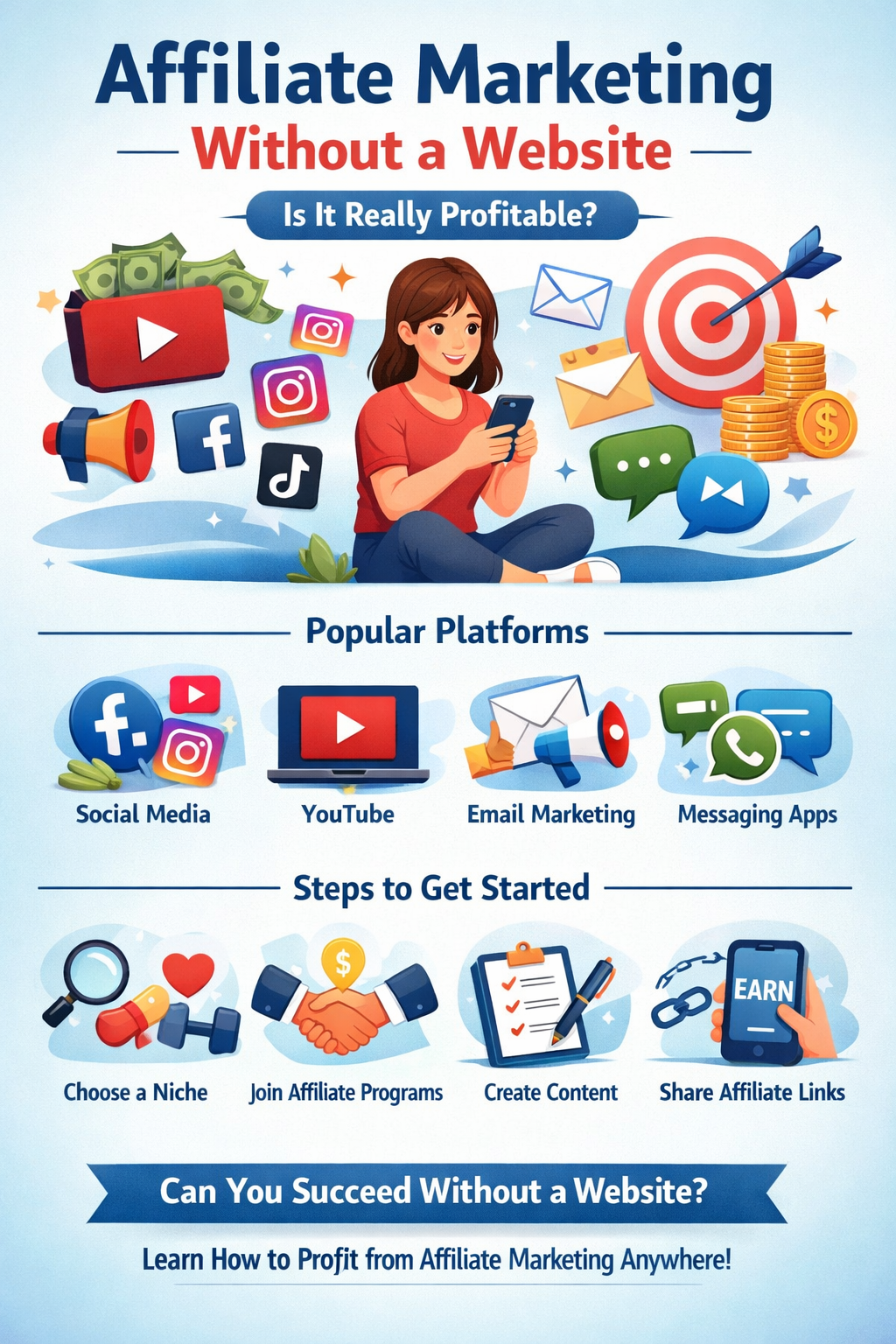
Affiliate Marketing Without a Website: Is It Really Profitable?
Affiliate marketing has become one of the most popular ways to make money online. It is often promoted as a low-risk business model that allows anyone to earn commissions by recommending products or services. However, many beginners believe that building a website or blog is mandatory to succeed.
In reality, affiliate marketing without a website is not only possible, but it is also increasingly common. With the rapid growth of social media, video platforms, and messaging apps, affiliates now have multiple channels to generate traffic and sales without owning a blog.
This article provides a complete guide to affiliate marketing without a website. You will learn how it works, the best platforms to use, SEO strategies, advantages and disadvantages, realistic income expectations, and whether it is profitable in the long term.
What Is Affiliate Marketing?
Affiliate marketing is a performance-based marketing model where an individual earns a commission by promoting a product or service owned by another company. Each affiliate is given a unique tracking link. When someone clicks the link and completes a purchase or action, the affiliate earns a commission.
The core components of affiliate marketing include:
- The merchant or product owner
- The affiliate marketer
- The affiliate link
- The customer
Affiliate marketing works because companies only pay for results, while affiliates can earn income without creating their own products.
Is a Website Required for Affiliate Marketing?
A website is not required to start affiliate marketing. While having a website provides more control and long-term benefits, it is not mandatory. Many affiliate programs allow promotion through social media, video platforms, email marketing, and messaging apps.
Affiliate marketing without a website is especially suitable for:
- Beginners with no technical skills
- People who want to start quickly
- Those with limited startup budgets
- Content creators and influencers
However, success depends on traffic quality, content value, and trust-building.
How Affiliate Marketing Without a Website Works
Affiliate marketing without a website follows the same core principles as traditional affiliate marketing. The only difference is the traffic source.
Instead of driving traffic to blog articles, affiliates send users directly to affiliate links from:
- Social media profiles
- Video descriptions
- Email newsletters
- Messaging groups
As long as the platform allows affiliate links and the audience trusts the content, conversions can occur.
Best Platforms for Affiliate Marketing Without a Website
Social Media Platforms
Social media platforms are among the most popular tools for affiliate marketing without a website. Instagram, TikTok, Facebook, and Twitter allow affiliates to reach large audiences quickly.
Common content formats include:
- Short-form videos
- Stories and reels
- Educational posts
- Live sessions
Affiliate links are typically placed in bios or through link aggregation tools. Success on social media depends heavily on consistency, engagement, and content relevance.
YouTube as a Search Engine
YouTube is one of the most powerful platforms for affiliate marketing without a website. It functions as a search engine, which makes it ideal for long-term traffic generation.
Affiliate-friendly content includes:
- Product reviews
- Tutorials and how-to guides
- Product comparisons
- Unboxing videos
Affiliate links can be added to video descriptions and pinned comments. Optimizing titles and descriptions with keywords such as affiliate marketing without a website improves discoverability.
Email Marketing Without a Website
Email marketing is one of the highest-converting affiliate marketing channels. Even without a website, affiliates can collect email subscribers using free landing pages or social media opt-ins.
The process involves:
- Offering valuable content or incentives
- Building trust through consistent emails
- Promoting affiliate products naturally
Email marketing works well because subscribers are already interested in the niche.
Messaging Apps and Private Groups
WhatsApp and Telegram allow affiliates to build direct relationships with their audience. Private groups create a sense of exclusivity and trust.
Affiliates can:
- Share product recommendations
- Provide tutorials and tips
- Offer exclusive deals
Because communication is personal, conversion rates are often higher compared to public platforms.
Online Communities and Q&A Platforms
Platforms such as Reddit, Quora, and Facebook Groups can also be used for affiliate marketing. The key is to provide genuine value before sharing any affiliate link.
Spamming links can result in bans, so affiliates must focus on solving problems and answering questions honestly.
Step-by-Step Guide to Starting Affiliate Marketing Without a Website
Step 1: Choose a Profitable Niche
A niche defines your target audience and content focus. Popular affiliate marketing niches include health, finance, technology, beauty, and online education.
Choosing a niche you understand helps build trust and consistency.
Step 2: Join Affiliate Programs
Some popular affiliate programs that allow promotion without a website include Amazon Associates, ClickBank, ShareASale, Shopee Affiliate, and Tokopedia Affiliate.
Always read program terms to ensure compliance.
Step 3: Select One Primary Platform
Focusing on one platform at the beginning prevents overwhelm. TikTok is ideal for viral reach, YouTube is suitable for evergreen traffic, and email marketing offers stability.
Step 4: Create Value-Driven Content
Successful affiliate marketing relies on trust. Content should educate, solve problems, or provide honest reviews.
Avoid aggressive selling. Instead, focus on helping your audience make informed decisions.
Step 5: Promote Affiliate Links Ethically
Transparency is important. Always disclose affiliate relationships and avoid misleading claims.
SEO Strategies for Affiliate Marketing Without a Website
Even without a website, SEO still plays an important role. Platforms like YouTube, TikTok, and Pinterest rely on search algorithms.
Key SEO strategies include:
- Using keywords in titles and descriptions
- Writing clear and relevant captions
- Using hashtags strategically
- Publishing content consistently
Keyword research tools such as Google Trends and Ubersuggest help identify search demand.
Advantages of Affiliate Marketing Without a Website
Affiliate marketing without a website offers several advantages:
- Low startup cost
- No hosting or domain fees
- Faster setup
- No technical maintenance
- Suitable for mobile users
This approach lowers the barrier to entry significantly.
Disadvantages and Limitations
Despite its benefits, affiliate marketing without a website also has limitations:
- Dependence on third-party platforms
- Risk of account suspension
- Algorithm changes affecting reach
- Limited long-term asset ownership
These risks make diversification important.
Is Affiliate Marketing Without a Website Profitable?
Yes, affiliate marketing without a website can be profitable. Many affiliates earn consistent income using social media, YouTube, and email marketing alone.
Typical income levels vary:
- Beginners may earn a few hundred dollars per month
- Intermediate affiliates can earn four figures monthly
- Advanced creators may generate five-figure incomes
Profitability depends on traffic quality, audience trust, product relevance, and consistency.
Website vs No Website: Which Is Better?
Affiliate marketing without a website is ideal for beginners and fast execution. However, websites offer greater control, scalability, and long-term SEO benefits.
A common strategy is to start without a website and build one later as income grows.
Common Mistakes to Avoid
Many beginners fail due to unrealistic expectations. Common mistakes include promoting too many products, ignoring audience trust, spamming affiliate links, and giving up too early.
Affiliate marketing is a long-term strategy that rewards consistency.
Long-Term Strategy for Sustainable Growth
To build sustainable affiliate income without a website, affiliates should:
- Focus on one niche
- Build personal branding
- Diversify traffic sources
- Reinvest profits into tools or ads
Eventually, adding a website can further strengthen long-term stability.
Final Thoughts
Affiliate marketing without a website is a legitimate and effective way to make money online. While it has limitations, it offers a low-risk entry point for beginners and content creators.
By focusing on value-driven content, SEO optimization, and trust-building, affiliates can generate consistent income without owning a blog. Over time, combining this approach with a website can create a powerful and sustainable online business.