
What Is Accounting? Audit, Tax, Financial, and Management Accounting
 Rifqi Arafat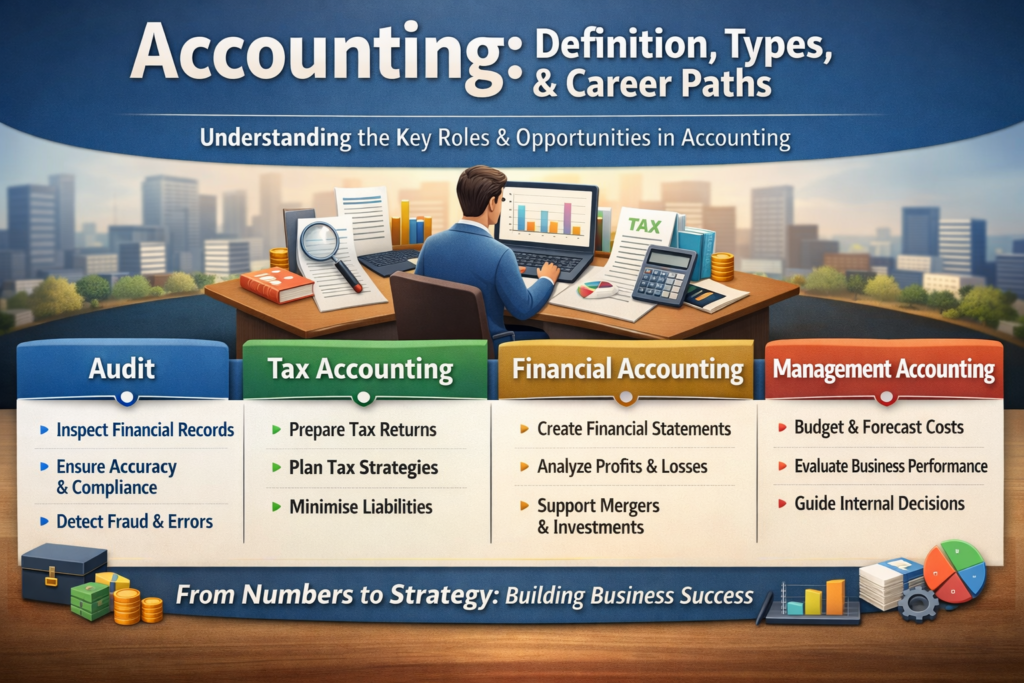
Accounting: The Business Skill That Quietly Runs Everything
Accounting is often described as “the language of business,” but that phrase doesn’t fully capture what it really is. Accounting is not only about recording transactions or preparing reports. At its core, accounting is the structured way businesses track income, assets, costs, risks, and performance over time—so leaders can make decisions based on facts, not assumptions.
Modern accountants do far more than basic bookkeeping. They evaluate whether a new technology actually reduces costs, measure efficiency gains, support mergers and acquisitions, help improve quality management, build information systems that track financial performance, design tax strategies, and even contribute to managing employee healthcare benefits. In other words, accounting is a practical profession that sits at the intersection of data, strategy, and accountability.
This article explains what accounting really involves, why it matters, and how the field is divided into major career paths such as audit, financial accounting, tax, and management accounting—complete with real-world examples and clear “how & why” explanations.
The Real Purpose of Accounting: Clarity, Control, and Credibility
Accounting exists because every organization needs answers to difficult questions:
- Are we actually making money—or just generating cash temporarily?
- Which products or departments are profitable, and which are quietly draining resources?
- Can we afford expansion, hiring, or a new warehouse?
- Are we following laws and tax rules correctly?
- If investors look at our reports, will they trust them?
Accounting provides reliable methods to answer those questions using consistent rules, evidence, and documentation. Without accounting, businesses don’t just “lose track of money.” They lose the ability to control operations and plan the future.
How accounting works in real life (and why it matters)
Imagine a growing online store that sells skincare products. Sales look great, and the owner feels confident. But at the end of the month, there’s barely any profit.
Accounting helps uncover the real story by tracking:
- Product costs (including shipping and packaging)
- Marketing spending (ads, influencer fees, discounts)
- Returns and damaged inventory
- Payment gateway fees
- Warehousing expenses
Why this matters: The business may be “busy,” but not “healthy.” Accounting turns activity into measurable performance.
The Three Main Branches of Accounting
Accounting careers are usually grouped into three broad areas:
- Audit
- Finance/Tax
- Management Accounting
Each path has its own focus, skill demands, and daily work rhythm. Some people thrive in structured verification roles, while others prefer strategic planning and decision-making.
Audit: The Guardian of Financial Trust
Audit work involves examining accounting records and financial statements in companies or government organizations. Auditors check whether financial reports are accurate, consistent, and compliant with standards.
Why audit exists
Organizations don’t operate in isolation. Investors, banks, regulators, and even employees rely on financial statements to make decisions. If the numbers are wrong—or manipulated—people can lose money, jobs, and trust.
Auditing exists to reduce that risk.
How auditors work (and what they actually do)
Auditors don’t just “check everything.” That would be inefficient and expensive. Instead, they:
- Study internal controls (who approves payments, who records transactions)
- Test samples of transactions (invoices, receipts, contracts)
- Validate account balances (cash, inventory, revenue, liabilities)
- Look for inconsistencies, errors, or signs of fraud
- Ensure compliance with accounting standards and regulations
Real example: A revenue recognition problem
A software company may record revenue immediately after signing a contract—even though the service will be delivered over 12 months. That makes profits look higher today, but it’s misleading.
An auditor flags this because revenue must match the period when value is actually delivered.
Why this matters: Accurate reporting protects decision-makers from false confidence and prevents financial scandals.
Budget Analysis: Planning Money Before It Disappears
Budget analysts develop and manage financial plans for organizations. While accountants often track what happened, budget analysts focus on what should happen next.
How budget analysis works
A budget analyst typically:
- Reviews historical spending patterns
- Estimates future costs and revenues
- Works with departments to plan spending
- Tracks budget vs. actual performance
- Recommends adjustments when reality changes
Why budget analysis matters
Even profitable organizations can fail if spending is uncontrolled. A budget is not just a document—it’s a tool for discipline.
Real example: A hospital managing limited resources
A hospital may need to decide whether to invest in new equipment, hire more nurses, or expand emergency services. Budget analysts help quantify trade-offs and prioritize based on impact.
Why this matters: Budgeting prevents financial chaos and helps organizations allocate resources strategically.
Financial Accounting: Building Reports That Leaders and Investors Trust
Financial accountants prepare financial statements based on the general ledger. Their work becomes the official “story” of a company’s financial health.
These statements include:
- Income statement (profit and loss)
- Balance sheet (assets, liabilities, equity)
- Cash flow statement (cash movement and liquidity)
How financial accounting supports big decisions
Financial accounting is not only about compliance. It supports major decisions involving:
- Mergers and acquisitions
- Long-term financial projections
- Retirement and benefits planning (including ERISA-related considerations)
- Investment decisions and funding strategies
Why financial accounting matters
A business can’t grow sustainably without understanding:
- Profitability trends over time
- Debt levels and repayment ability
- Asset value and depreciation
- Cash availability
Real example: Preparing for a merger
If Company A wants to acquire Company B, financial accountants help ensure the target company’s financial statements are reliable. They also help evaluate:
- Hidden liabilities
- Revenue stability
- Inventory accuracy
- Long-term obligations
Why this matters: Bad financial reporting leads to bad deals. And bad deals can destroy companies.
Tax Accounting: Legal Strategy, Not Just “Filing”
Tax accountants prepare corporate and individual tax returns, but their real value is in strategy. They help organizations manage tax obligations legally and efficiently.
How tax accountants think (and why it’s complex)
Tax work often involves decisions such as:
- Choosing the best financial structure for a business
- Managing tax timing (when to expense costs vs. capitalize them)
- Handling mergers or acquisitions with minimal tax exposure
- Planning for deferrals, credits, and deductions
- Ensuring compliance while reducing unnecessary tax burden
Why tax accounting matters
Taxes can be one of the largest expenses for businesses. Paying too much reduces growth. Paying too little—incorrectly—creates legal risk.
Real example: Timing expenses to manage tax
A company might buy expensive equipment late in the year. A tax accountant evaluates whether it should be expensed immediately (reducing taxable income now) or depreciated over time.
Why this matters: Small timing decisions can change cash flow significantly—especially for fast-growing businesses.
Management Accounting: The Internal Advisor Behind Smart Decisions
Management accountants work inside companies and support decision-making. Their focus is not on external reporting, but on improving internal performance.
They help with:
- Capital budgeting (which investments are worth it)
- Business line analysis (which products/services are profitable)
- Cost control and efficiency planning
- Performance measurement systems
How management accounting works in practice
Management accountants often use tools like:
- Cost-volume-profit analysis
- Break-even analysis
- Variance analysis (budget vs. actual)
- Activity-based costing
- KPI dashboards tied to financial outcomes
Why management accounting requires high-level thinking
Unlike financial accounting, which follows strict standards, management accounting must adapt to business reality. It requires judgment, problem-solving, and the ability to connect financial data to operations.
Real example: A restaurant deciding what to remove from the menu
A restaurant might assume its most popular dish is also the most profitable. A management accountant breaks down:
- Ingredient costs
- Preparation time (labor cost)
- Waste levels
- Pricing strategy
The result might show that a “fan favorite” actually earns less than other items.
Why this matters: Management accounting prevents businesses from making decisions based on intuition alone.
Skills That Matter Across Accounting Careers
Accounting requires more than math. It requires the ability to communicate, analyze, and synthesize information into decisions.
Speaking and communication skills (required everywhere)
No matter the division, accountants must explain financial information to non-accountants—managers, clients, regulators, or teams.
Why this matters: Great analysis is useless if nobody understands it or acts on it.
Synthesis skills (vary by specialization)
Different areas demand different levels of synthesis:
- Audit: medium-level synthesis (testing evidence and forming conclusions)
- Tax and financial accounting: lower synthesis compared to management roles, but still requires accuracy and interpretation
- Management accounting: high synthesis (connecting numbers to strategy and operational choices)
What Entry-Level Accounting Work Really Looks Like
Many beginners imagine accounting as solo work with spreadsheets. In reality, entry-level accountants often work in highly team-oriented environments.
They may start as junior team members responsible for tasks like:
- Auditing key accounts under supervision
- Preparing financial statements or supporting schedules
- Cleaning and reconciling data
- Testing transactions and documenting results
How new accountants succeed early (and why teamwork matters)
The fastest way to grow is not just learning technical rules, but learning how to be useful in a team:
- Ask smart questions, not constant questions
- Document work clearly so others can review it
- Meet deadlines consistently
- Understand the purpose behind tasks, not just the steps
Why this matters: Accounting is built on trust. Teams trust people who are accurate, reliable, and organized.
Why Accounting Careers Keep Growing
According to labor statistics, accounting job openings have increased significantly, reflecting both growth and competition in the field. This makes sense because accounting is tied to business activity: as organizations grow, regulations expand, and technology changes, the need for financial professionals increases.
The technology shift: Accounting is evolving, not disappearing
Automation has reduced repetitive tasks, but it has increased demand for accountants who can:
- Interpret results
- Evaluate business risks
- Design better systems
- Support strategic decisions
Why this matters: The future accountant is not replaced by software. The future accountant works with software and becomes more strategic.
Big Firms and Career Launchpads: Where Many Accountants Start
Well-known firms in public accounting have historically included:
- KPMG / Peat Marwick
- Ernst & Young
- Deloitte & Touche
- Arthur Andersen
- PricewaterhouseCoopers
- Grant Thornton
- BDO Seidman
- McGladrey and Pullen
Many graduates consider entry-level roles in these firms because they offer strong training and exposure to complex clients.
Why public accounting is a powerful starting point
Most people don’t become partners in public accounting firms. But the experience can be extremely valuable because it builds:
- Technical skills under pressure
- Client communication ability
- Strong professional discipline
- A network that opens future opportunities
After that, many professionals move into accounting-focused careers in business or government.
A Unique Perspective: Accounting Is a Decision Profession, Not a Recording Profession
Here’s a perspective that many people miss:
Accounting is not primarily about recording the past. It’s about controlling the future.
Yes, accounting tracks what happened. But the real impact comes when accountants use that information to:
- prevent waste
- detect risk early
- guide investment decisions
- improve profitability
- protect an organization’s credibility
That’s why accounting remains one of the most resilient and respected careers across industries.
Conclusion: A Practical Career With Real Impact
Accounting is a vital field because it provides structure and truth inside complex organizations. Whether you choose audit, financial accounting, tax, budget analysis, or management accounting, you are stepping into a profession that influences how decisions are made—and whether businesses survive.
If you want a career that combines logic, stability, and long-term growth, accounting offers a strong path. But the best accountants don’t stop at “doing the numbers.” They learn how to explain them, challenge them, and use them to improve outcomes.
In a world full of business noise, accounting remains one of the few disciplines that turns activity into clarity—and clarity into results.