
Which Country Celebrates New Year 2026 First and Last? Here’s the Complete Timeline
 Rifqi Arafat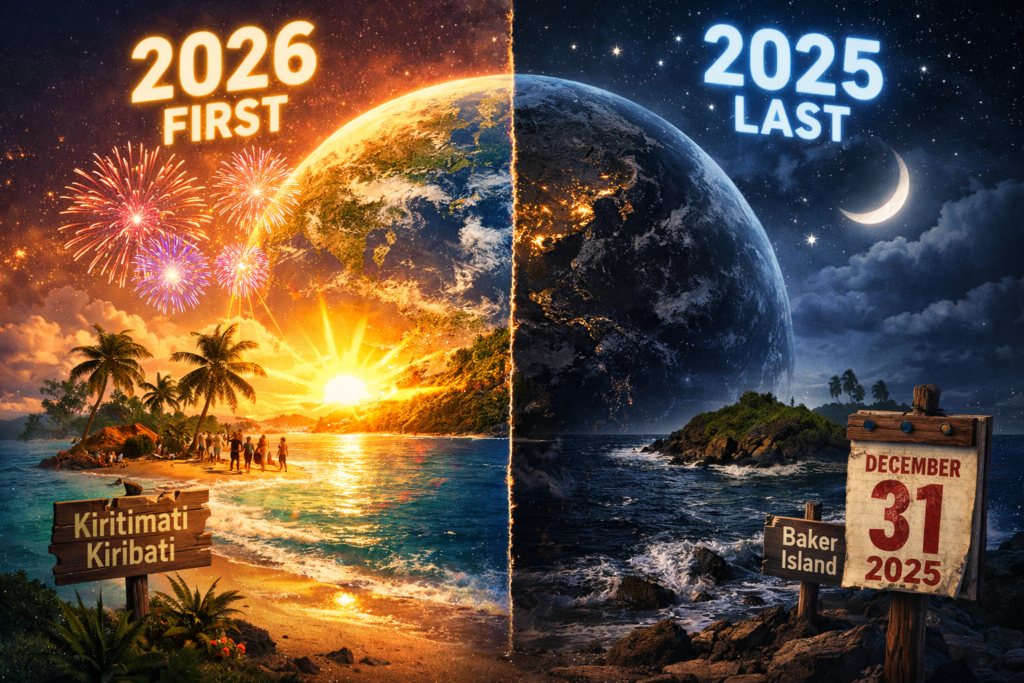
Welcoming 2026 Around the World: From the First Place to Enter the Future to the Very Last
New Year’s midnight isn’t a single moment—it’s a moving wave. Here’s why some places greet 2026
long before others, and which regions are first and last on Earth.
New Year’s celebrations are often associated with fireworks, countdowns, and fresh hopes for the future.
However, one fascinating fact is often overlooked: the New Year does not arrive at the same moment everywhere on Earth.
While some people are still preparing for New Year’s Eve festivities, others have already stepped into 2026—almost a full day earlier.
This phenomenon is not a coincidence. It is the result of the global time zone system and the presence of the
International Date Line, an invisible boundary that helps determine when a new day begins.
From this system arises an intriguing question: which places are the first and the last to celebrate the arrival of 2026?
Why Doesn’t the World Enter the New Year at the Same Time?
The Earth rotates from west to east, causing different regions to experience daylight and nighttime at different moments.
To organize this natural rotation, humans created time zones. Alongside this system lies the
International Date Line, which runs mostly through the Pacific Ocean and marks the point where one calendar day changes into the next.
Because of this line, some parts of the world welcome the New Year much earlier than others. In fact, the time difference between the
earliest and latest celebrations can reach approximately 26 hours, turning the New Year into a gradual global relay rather than a single, synchronized event.
The First Place to Welcome 2026
Kiritimati, Kiribati: Stepping Into the Future First
The title of the world’s first place to welcome the year 2026 belongs to Kiritimati Island (Christmas Island),
part of the Republic of Kiribati. Located in the UTC+14 time zone, Kiritimati sits at the very front edge of Earth’s clock.
While much of the world is still living through December 31, 2025, residents of Kiritimati have already entered January 1, 2026.
New Year’s Day arrives in Kiritimati on December 31, 2025, at approximately 5:00 PM WIB.
Because of this unique position, Kiribati is often described as a place that “meets the New Year first,”
becoming an early witness to the first sunrise of the year.
Other Early Celebrators in the Pacific
In addition to Kiribati, several regions in the Pacific Ocean are among the earliest to welcome the New Year, including:
- The Chatham Islands (New Zealand)
- Tonga
- Samoa
- Mainland New Zealand
By the time many Asian countries begin their countdowns, celebrations in these regions are already winding down.
The Last Places to Enter 2026
Baker Island and Howland Island: The Final Countdown on Earth
On the opposite side of the globe lie Baker Island and Howland Island, two small,
uninhabited islands owned by the United States. These islands are located in the UTC−12 time zone,
making them the last places on Earth to welcome the year 2026.
In other words: while people in Kiribati are well into January 1, many regions have already celebrated and moved forward—
yet these islands are still holding onto the final minutes of December 31, 2025.
New Year’s Day arrives here on January 1, 2026, at around 7:00 PM WIB.
The Last Inhabited Region: American Samoa
Since Baker and Howland Islands have no permanent residents, the title of the last inhabited place
to celebrate the New Year belongs to American Samoa. People living there experience the arrival of 2026 long after most of the world has already moved on.
How the New Year Travels Across the World (Seen from Indonesia)
From Indonesia’s perspective (WIB), the New Year feels like a wave moving steadily from east to west:
Kiribati (Kiritimati) enters 2026 first.
Australia, Japan, and South Korea celebrate soon after.
Indonesia (WIB), Thailand, and Vietnam welcome the New Year.
Europe joins the celebration.
The Americas follow.
Hawaii and American Samoa approach the New Year.
Baker Island & Howland Island are the last to enter 2026.
Interesting Facts About the New Year
- The global New Year celebration spans more than a full day due to time zones.
- Countries like Russia and the United States celebrate multiple New Years across different time zones.
- Kiribati adjusted its time zone in the 1990s so the entire country would share the same calendar day.
Conclusion
The arrival of the New Year 2026 is not just about fireworks and resolutions—it is a global journey shaped by Earth’s rotation.
From Kiritimati in Kiribati, the first place to greet 2026, to Baker and Howland Islands,
the final points on the planet to let go of 2025, time moves in a fascinating procession across the globe.
This phenomenon reminds us that although we share the same calendar year, our experience of time can be profoundly different
depending on where we stand on Earth.