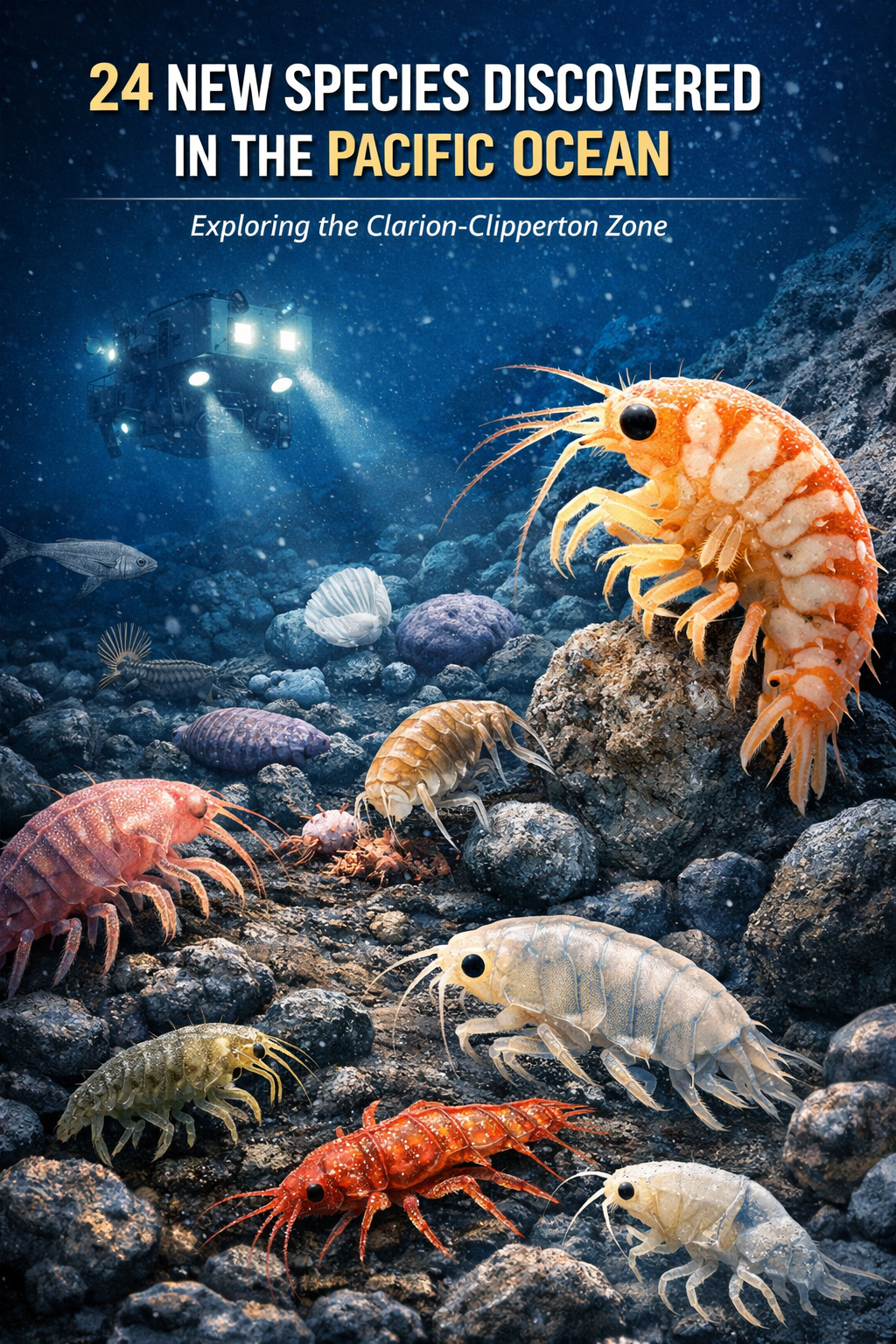
Scientists Discover 24 New Species in the Pacific Ocea
Deep in the central Pacific Ocean, specifically in the Clarion-Clipperton Zone (CCZ), scientists have discovered previously unknown marine species. A research team from the Department of Invertebrate Zoology and Hydrobiology at the University of Lodz identified and described 24 new species of amphipods from this region.
This study is part of a broader effort to document biodiversity in the CCZ, a vast area covering about 6 million square kilometers between Hawaii and Mexico. The research also contributes to the “One Thousand Reasons” project, which aims to describe 1,000 new marine species by the end of this decade.
According to Dr. Tammy Horton from the National Oceanography Centre (NOC), describing newly discovered species is an important step in documenting biodiversity in the CCZ and enables scientists to better communicate about these organisms.
New Families and Superfamilies Identified
The 24 species belong to 10 amphipod families, including Ampeliscidae, Eusiridae, Lepechinellidae, Liljeborgiidae, Pardaliscidae, Phoxocephalidae, Stilipedidae, Synopiidae, and Tryphosidae, along with a newly identified family called Mirabestiidae.
Notably, both the family Mirabestiidae and the superfamily Mirabestioidea are newly recognized in this study, representing a completely new branch in the evolutionary tree. Scientists also found species with different ecological roles, including predators and scavengers.
Horton described the discovery of a new superfamily as extremely rare and memorable.
Naming the New Species
Each newly discovered species must be given a scientific name following the rules of the International Commission on Zoological Nomenclature (ICZN), typically consisting of two Latin words (genus and species).
The names often honor researchers, such as Byblis hortonae, named after Tammy Horton. Some are inspired by family members, like Mirabestia maisie, named after Horton’s child. Others may recognize institutions, such as Eperopeus vermiculatus, named in honor of the World Register of Marine Species (WoRMS).
Interestingly, some names are influenced by popular culture or personal experiences, such as Lepidepecreum myla, inspired by a video game character, and Pseudolepechinella apricity, symbolizing warmth and friendship.
Importance of the Discovery
Naming and identifying these species is crucial because more than 90% of deep-sea species in the CCZ remain unnamed. This work is considered an important first step toward understanding the region’s unique ecosystem.
Anna Jażdżewska from the University of Lodz emphasized that this collaborative study is a significant step toward the ambitious goal of describing many new species each year—something that would be impossible to achieve individually.
The findings are also vital for future conservation decisions and policies, highlighting the importance of continuing research in deep-sea environments.